






Архивы Reviews - Cabrio | CabrioGE

Cars for Guests at a Private Event in Georgia

Guests rarely arrive as one group for a private dinner, wedding or anniversary celebration in Georgia. Some need an airport pickup, others are already staying in Tbilisi, a family with a child plans to leave after dinner, and someone else will stay until the evening ends. Booking cars for everyone is straightforward. Making sure nobody waits for another flight, looks for a driver at the wrong entrance or wonders how to get back to the hotel at night takes more planning.

Start with the guests’ schedules. They will show where a separate sedan makes sense, where a minivan is more practical and which journeys can be removed altogether. When contacting CabrioGE, that plan is more useful than a list of preferred brands: it gives you a basis for discussing specific pickups, passenger capacity and drivers’ working hours.

Start by separating the day into individual journeys

The airport pickup, the journey from the hotel to the venue and the return after the event are three different tasks. Do not automatically assign one car to a guest for the entire day. There may be several hours at the hotel between arrival and dinner when the guest does not need it.

Yet the journeys cannot always be treated as independent. If the car coming from the airport must then collect another group from a hotel, a flight delay affects both pickups. Build that connection into the plan only with enough time in between and a clear arrangement for delays.

Create one list with each guest or family’s name, flight number, airport, local arrival date and time, hotel, passenger count, luggage and preferred return time after the event. Pay particular attention to dates for overnight flights: departure and arrival may fall on different calendar days. If a guest flies into Kutaisi for an event in Tbilisi or Kakheti, treat their intercity transfer as a separate task while the flights are still being agreed.

Identify anyone who needs an individual schedule. This could be parents with a young child, an older relative, a guest with limited mobility or a business partner with a meeting before dinner. These needs can justify a separate car before you choose its category.

In Tbilisi, there is little point in bringing everyone to one hotel just to depart together. If some guests are staying in Vake and others in Sololaki, compare direct pickups with a route collecting people at each address. A shared minivan works when people are genuinely traveling together, rather than making the first group collect everyone else across town.

An airport pickup ends when the guest reaches the car

The aircraft’s landing time is not the guest’s exit time. Arrival formalities and baggage collection still follow, sometimes with a visit to report a missing suitcase. The driver therefore needs the flight number, and the organizer needs agreed waiting terms.

Tbilisi Airport has an official arrivals board. Use it to check flight status alongside the airline’s information. But a flight marked as landed does not mean the passenger is ready to get into a car. The final confirmation that the guest is coming out should come from the guest or the person meeting them.

The airport identifies the arrivals hall as a place to meet arriving passengers. Specify the exact meeting point in the transfer confirmation: where the greeter will stand, what the sign will say and how to recognize them. For a private event, agree on the guest’s name or a neutral group name. There is no need to display the complete guest list.

The guest’s message should fit on one screen: meeting point, agreed wording on the sign, the greeter’s contact details and the organizer’s responsible contact. Send it before departure in a language the guest understands, so they can save it and find it without searching through a conversation.

Meeting in the hall and getting into the car happen at different points. Clarify who escorts the guest to the vehicle and helps with luggage, where the car waits and how parking is paid for. The airport website has a parking calculator, but the total transfer price also depends on whether the operator includes that cost in the quote.

Two flights scheduled close together do not necessarily make a good shared pickup. Decide in advance how long one group is willing to wait for the other and what happens if the second flight is delayed. After an overnight flight, a separate journey to the hotel may be worth more than the saving on one pickup.

Assign cars according to passengers, luggage and schedules

A guest’s status may determine the vehicle category, but it does not replace other requirements. For a business partner traveling separately, agree on the model or category, whether the ride is private, the driver’s language and communication through an assistant if one is managing the trip. A confidential conversation is difficult to plan in a shared minivan.

For a family, child seats and luggage come first. Provide the children’s ages, heights and weights, the number of suitcases and the dimensions of the folded stroller before confirming the vehicle. A child seat takes up cabin space, while a third row in use changes luggage capacity. “Seven seats” alone does not tell you whether the whole group and their belongings will fit.

A sedan can suit an individual guest, a couple or a small group once luggage capacity is confirmed. A minivan works for people sharing a route and departure time. Choose an SUV when access conditions or a particular cabin layout justify it; its high seating position may be inconvenient for someone who finds it difficult to climb into a vehicle.

For a guest with limited mobility, clarify how they will get in, what assistance they need and the dimensions of any mobility equipment. Do not assume that an ordinary spacious car is an accessible vehicle without checking. Resolve these questions with the accompanying person in advance so they do not have to be discussed beside the car.

The passenger group at the airport may differ from the group going to the event. Suitcases will stay in hotel rooms, someone may leave for the venue early, and a family may return separately. Confirm capacity and assignments for each stage, rather than once for the whole event.

Confirm the venue entrance and boarding area

For a city restaurant or hotel, check the entrance guests will actually use. The main map pin may lead to reception, while dinner takes place in another building or on a terrace with a separate approach. The driver needs the exact location and a contact at the venue.

During a site visit, ask whether guests can be dropped off at the entrance, where a minivan can turn and where vehicles can wait. In summer, guests should not be left standing in the sun while waiting to board. In rain, the route from the door to the car should be clear and as short as possible. Do not promise pickup directly outside the event room until the venue confirms access.

For an event in Kakheti, first decide where guests will sleep. Traveling from Tbilisi for dinner and returning that night is a different plan from staying near the venue, especially when wine and a late finish are part of the evening.

An event with accommodation is an option in Tsinandali, for example. Tsinandali Estate, A Radisson Collection Hotel, offers rooms and spaces for private events. That does not mean every guest has to stay there. However, staying on site can remove the overnight intercity transfer. Room availability, booking terms and the route from the event space to the rooms need to be agreed separately.

If guests are returning to the capital, do not assign the same vehicle to an early journey to Tbilisi and another pickup in Kakheti without calculating its complete round trip. Include travel in both directions, drop-off, possible stops and a suitable buffer. Once a car has left, it is no longer available to the guests who remain.

Do not use a single journey time “to Kakheti,” either. A venue near Telavi and an address near Sighnaghi require different routes. Calculate from the actual hotel or airport to the specific entrance, taking the travel date and road conditions into account.

Arrange the return before the evening starts

One shared pickup at the end of the program works only if everyone wants to leave at the same time. For a private event, it is often more useful to establish at least two preferences in advance: who would like to return after dinner and who intends to stay until the end.

You can agree on an early departure for families and a departure after the program for the main group. If someone needs to leave whenever they choose, that is a separate requirement: a car waiting at the venue or an agreed on-call pickup. An empty seat in a car that has already left does not help.

Distinguish waiting at the venue from returning for a scheduled pickup. In the first arrangement, the car remains available during an agreed period. In the second, it arrives at a set time. Discuss changes to that time, the required notice and additional charges before the event.

In Tbilisi, taxis may be enough for a few independent guests who are happy to book their own rides. For an organized group, establish who places the bookings and pays. Ordinary app bookings cannot be treated as a promise that matching vehicles will arrive simultaneously.

For a late return from a countryside venue, have transport confirmed. If alcohol is part of the event, do not make a guest the designated driver simply because they arrived in a rental car. Arrange the return so they do not have to choose between taking part in the evening and driving others.

The next day matters, too. An early flight after a late dinner needs its own pickup time, packed luggage and an airport arrival plan based on the airline’s requirements. Do not leave it as a verbal arrangement with the driver handling the overnight transfer.

Backup transport and coordination need clear arrangements

Backup means either a dedicated vehicle for an agreed period or confirmed replacement availability with clear terms and an estimated pickup time. “We will find another car if necessary” does not tell you how long a guest may wait.

For a small dinner, a separate standby vehicle may be an unnecessary expense. For an event outside the city, several arrivals or a strict protocol schedule, disruption carries a greater cost. The decision depends on whether a journey can be moved, guests can share or a replacement can arrive without affecting the program.

Appoint one person to authorize changes on the organizer’s side and agree on a primary contact with the transport provider. This does not have to be a separate job or an additional service. What matters is that drivers do not receive conflicting instructions from the host, the restaurant manager and several guests.

The person responsible needs the current journey list. Each driver needs their route, passengers, pickup points and working contacts. Any change to the return time should be acknowledged by both sides. A guest mentioning a request over dinner does not mean the driver has received a new instruction.

At the venue, agree who checks that the group is ready and gives the signal to board. Invite guests to the exit once the car’s arrival is confirmed, rather than gathering them beside the road early. If several vehicles are being used, assign guests to cars before they leave the room.

When comparing quotes, look at the full scope: individual pickups, waiting, return visits, parking, night service, extra addresses, child seats and backup. Ask about the deadline for changing vehicle numbers and the cancellation terms. The lowest price for one journey tells you little about the cost of the entire evening.

What to confirm before the event

Give the operator one current version of the plan and check that the following points are agreed.

  • Flights and arrival dates have been checked, and someone is responsible for tracking changes.
  • Passengers, luggage and child seats have been assigned for every journey.
  • Meeting points, sign wording and guest messages are agreed.
  • Driver or greeter details, the organizer’s contact and the venue contact are available to those who need them.
  • The venue has confirmed access, drop-off, waiting and the evening boarding point.
  • Return times, early departures and morning transfers are included in the plan.
  • The operator has confirmed backup arrangements, additional charges and changes.

You can request airport transfers and city or intercity journeys with a driver from CabrioGE. Specify night service, child seats and multiple addresses when booking. If the event needs several cars, a single coordinator or backup transport, confirm those arrangements and terms separately for your dates.

Send CabrioGE the event date, venue, hotels, flights, guest count and luggage details, along with preferred return times. This plan provides a basis for discussing vehicles and requesting a quote for the individual journeys.

A Month in Tbilisi Without Your Own Car

You have booked an apartment in Tbilisi for a month. You plan to work from home, the cafés look close on the map, and you would like to get out of town a couple of times. Renting a car for the whole stay seems unnecessary. Add school runs, meetings across town and evenings carrying groceries home, however, and the decision becomes less straightforward.

Spending the month without a car at your disposal is entirely possible. The question is how many journeys you can choose freely and how many you have to make at a set time every day. At CabrioGE, we suggest starting there: the same car can be useful for a family with daily trips and barely needed by someone who works from home and walks around the neighborhood.

The apartment’s address matters more than the neighborhood’s name

For a month in Tbilisi, “a good neighborhood” is too broad a description. You need the building’s entrance, the nearest grocery store, the walk to public transport and the addresses you will visit regularly. Check them before paying for accommodation. Once you move in, an inconvenient route becomes a daily expense.

In Saburtalo, assess an apartment in relation to a specific metro station, such as Technical University, Medical University or Delisi. The neighborhood’s name alone does not mean the metro is nearby. Check the walk from the destination station to work as well: an easy first leg helps less if there is a long walk at the other end.

In Vake, if your routine centers on home, the park and nearby cafés, you may be able to do many things on foot. But there is no metro station at Vake Park. For regular journeys elsewhere, you will need to assess a bus route or taxis. An apartment on Chavchavadze Avenue and one farther up the hillside are different propositions, even when their listings sound similar.

In Sololaki, proximity to Freedom Square is useful for walking around the city. Yet the route between a particular building and the square may involve a hill, and a short walk may include stairs. Picture the return journey with groceries or a stroller. In summer, assess it during the day, too, rather than relying on evening photographs of the street.

Consider Didi Dighomi through your own destinations: the school, work, grocery store and places you need to reach in the evening. If your everyday activities are nearby, being farther from the tourist center may make no difference. If you will travel to Vake or central Tbilisi every weekday, compare the complete journey with an alternative apartment. Cheaper accommodation does not necessarily mean lower overall costs.

Before booking, ask for the exact entrance location and find out where a taxi can pull up. If you are already in Tbilisi, walk the proposed route and try the essential journey on the relevant day and at the relevant time. That tells you more than another ten photographs of the living room.

What the metro, taxis and deliveries can cover

For regular journeys, assess public transport by route first and price second. Under TTC’s published fares, GEL 1 covers 90 minutes of municipal transport travel within the applicable fare system. An unlimited monthly pass costs GEL 40 and must be purchased on a subscription card. Paying with an ordinary bank card does not automatically turn your spending into a monthly pass.

This is a modest fixed part of your budget if the metro or bus connects the places you need. But there is no reason to buy a pass simply because you are staying for a month. If you work from home and travel occasionally, paying as you go may be enough. TTC’s services let you check routes, transfers and timetables in advance.

On suitable routes, the metro helps because it is independent of road traffic. You still need to add the walk to the station and from the exit to your destination. With a stroller, heavy bags or limited mobility, assess the entire journey, including access to the platform.

For other trips, services such as Bolt operate in Tbilisi. A taxi is particularly useful for dinner, a late return or a meeting where you do not want to find parking. Check the fare and pickup estimate for your address in the app. One successful midday booking is not enough to estimate a month of morning journeys.

Compare the car category you actually intend to use. If you need a roomier vehicle, do not build your budget around the cheapest category and then choose another one every time. A suitable child seat also needs a separate arrangement: an available taxi does not settle that question.

Delivery removes some errands. Wolt in Tbilisi offers groceries, restaurant meals and other retail categories. Before choosing an apartment, enter its address and check the available selection, fees and relevant stores’ hours. A service operating in the city does not mean identical conditions at every building.

If your main reason for renting a car is bringing home heavy groceries once a week, calculate delivery costs first. Look beyond the delivery fee and compare the price of your usual basket, too. Trips to buy fresh produce that you enjoy making can still remain part of everyday life.

A solo traveler, a couple and a family get different answers

Someone who works remotely and meets colleagues a few times a week may be well served by a walkable location and a mix of metro and taxis. A car cannot shorten a commute you do not have. It makes sense to live without one initially and see which journeys actually recur.

A couple brings two schedules. If both people work at home and usually go out together in the evening, transport costs do not necessarily double. If one travels to an office every day and the other goes elsewhere, count their routes separately. One rental car cannot take both of them in opposite directions at the same time, either.

For a family, the school or kindergarten matters more than proximity to restaurants. A parent might drop a child off, return home to work, travel back for pickup and then come home again. That makes four separate journeys a day. Over 20 such days, it adds up to 80 journeys before extracurricular activities and weekends. This is an example, not every family’s routine, but it shows how easily trips can be undercounted.

A car available throughout the stay may be more convenient here: the child seat is installed, the stroller does not have to fit into an unfamiliar trunk each time, and you can leave when the family is ready. In return, one adult takes responsibility for driving and parking. If school is walkable or offers suitable transport, the case for a month-long rental becomes weaker.

For a manager with several meetings a day, the pattern of travel matters as well. One office in the morning and a journey home in the evening is one task. Several addresses, with documents or equipment in the car, is another. Taxis, however, remove the need to park and return to a vehicle left behind. If you need to make calls between meetings, that may matter more than having a car outside your building.

What a month costs with and without a car

A comparison only works for the same schedule. Do not compare taxis during a quiet working week with a rental you have already mentally assigned to four weekends in the countryside.

For the option without a permanent car, add city rides, public transport, airport journeys and rentals or transfers for specific outings. For the car option, add the quote for the full rental period, fuel, parking at home and at your destinations, and agreed extras. Taxis after dinner with wine may remain part of the budget.

Start with one typical week. Write down the essential journeys by direction: morning and evening can differ. Check several fare estimates in the app at the times you expect to travel. Save them as a guide and compare them with actual spending after arrival. There is no need to book cars just to check prices.

Then use simple arithmetic. With 20 working days and two journeys a day, you have 40 journeys. If those particular journeys cost an average of GEL 5 more than you allowed for, the month costs GEL 200 more. This is a budget sensitivity check, not a forecast of taxi fares in Tbilisi.

Estimate fuel using your expected mileage: monthly kilometers × the chosen car’s consumption per 100 kilometers ÷ 100 × the price per liter. Use city consumption and add journeys out of town separately. The lowest figure in a model description may not reflect your driving pattern.

Request a rental quote for the actual dates. Multiplying a daily rate by 30 is not a substitute for a long-term quote. If prices are in different currencies, convert them to one currency using the actual payment terms. Ask about the deposit and how it is returned. A refundable deposit is not the same as an expense, but it affects how much money you need when collecting the car.

One further calculation is often missed: accommodation plus transport. If a better address turns two daily journeys into walks, it may offset part of the higher rent. Conversely, an apartment with its own parking space may be more practical than one where you have to leave the car somewhere else each evening.

Resolve parking before renting

“Courtyard parking” needs clarification. Does the apartment have an allocated space? Is it included in the rent? Can a tenant open the barrier? Is the space available throughout your stay? An empty area in a photograph answers none of those questions.

On the street, check signs and payment requirements for the specific location through the city parking service. Do not assume one parking area’s conditions apply throughout Tbilisi. If the landlord or rental company says parking is paid for, ask exactly what that payment covers and where it applies.

You need a space at your destinations as well as at home. For regular meetings, find out whether the office has parking and how far you will have to walk to the entrance. With a busy schedule, being dropped off at a suitable spot may be more useful than having a car you then need to leave somewhere.

For a month-long stay, choose a vehicle you can comfortably park in the available space. A compact car or sedan is worth considering for one person or a couple. A family needs to check child-seat installation and room for belongings. An SUV makes sense for specific roads or cabin requirements; its size may add inconvenience on city errands.

Two trips out of town do not require a car for the whole month

If weekdays are spent near home and your plans include a day in Mtskheta and a couple of nights in Kakheti, you can arrange those trips separately. Compare a few rental days with a monthly quote, keeping city taxis and public transport in the calculation. A rental car may be useful for occasional outings even if it would sit unused on other days.

Plan collection and return around your working schedule. Check whether you can collect the car the evening before or on the morning of departure, where you will return it and how many chargeable days that involves. Plan the route in advance. For a trip with tastings, consider a driver if all the adults intend to drink wine.

CabrioGE offers long-term rentals from 30 days with individually agreed terms. Compare that option with separate bookings when you need a car regularly, such as for a daily family route and most weekends. When discussing the quote, clarify the total price, insurance terms and renter liability, extensions, servicing and early return.

If your address and routine are still undecided, you do not have to choose transport for three months at once. You can begin with city journeys and revisit the calculation after a normal working week. If your daily route is already known, it makes sense to arrange a car in advance, together with parking, child seats and terms for an additional driver.

Send CabrioGE your dates, neighborhood, passenger count and main weekly routes. With those details, you can request quotes for the full stay and for individual outings, then compare both with your own taxi budget.

How Many Places Should You Include in a Family Trip to Georgia?

It is easy to put together a week in Georgia that includes Tbilisi, Kakheti, Kazbegi and Batumi. On a map, the route looks convincing. Add the hotel nights beside each destination, though, and you may find the family packing almost every other morning. Between check-ins, there is lunch, travel, finding a restroom and the walk you promised the children, by which time everyone is tired.

For a first trip of seven nights, we would choose two main bases. With ten nights, three can work if the children travel well and everyone enjoys moving between destinations. This is a starting point for planning, not a rule for every family. You can see plenty while staying in two hotels, provided the outings really are short and you have somewhere to return for a rest.

Start by counting hotel changes

A base is somewhere you stay for several nights and take outings from. From Tbilisi, for example, you can visit Mtskheta separately and return to the same room. You have added another place to the trip without needing to pack.

Changing hotels often complicates a day more than visiting another sight. In the morning, you need to pack and vacate the room. At the next hotel, your room may not be available until the stated check-in time. Even when the journey is short, there can be a gap in which you need to find lunch, change a child’s clothes and perhaps arrange a nap.

Count the full days you have in each place. Two nights give you one day without a transfer; three nights give you two. If you chose a country hotel for its pool, walks and leisurely breakfasts, a single day between arrival and departure may feel too short.

Include the return to Tbilisi before your flight home as well. It is not another region, but it is another day of packing and checking in. Do not treat it as a spare day for Kazbegi, a distant monastery or a winery you did not manage to visit earlier.

Age changes the plan, but your child’s habits matter more

With a child who needs an afternoon nap in the room, it is easier to start with two bases and one main outing each day. Spend the morning exploring, then have lunch and return. After the rest, leave room for a playground, the pool or a walk near the hotel. Parents still get to see Georgia without trying to spend every daylight hour away from their accommodation.

In Tbilisi, a short walk through Rike Park and across the Bridge of Peace fits this approach. Save Mtatsminda for another day: the funicular, the park itself and a few activities already make up a separate outing. You also need to get to the lower funicular station on Chonkadze Street, particularly if you are coming from another part of the city with a stroller.

With a school-age child, you can plan a longer outing if the destination interests them. An amusement park, a historic house museum and a walk to a mountain church call for different kinds of attention and stamina. Being happy to spend several hours in a museum does not mean being ready to walk a trail for that long. Enjoying mountains does not necessarily make a child a patient passenger on a winding road.

Let a school-age child choose one activity that makes them want to visit the region. The day then has a purpose they understand. Avoid promising a particular ride based on a photograph, though. Before buying tickets, check the height, age and adult-accompaniment requirements.

If you have several children, it makes sense to plan the main activities around the one who tires most quickly. With two adults, you can split part of the day: one stays with the younger child for a rest while the other takes the older child out. A hotel with things to do nearby, without another drive, is particularly useful for this.

Choosing two bases in Georgia

Tbilisi is a convenient first base if you arrive there. Avoid booking an early-start excursion straight after an overnight flight. Choose a few city activities for the first days and spread them across different mornings or evenings. In summer, avoid scheduling a long walk along exposed streets in the middle of the day. When choosing a hotel, look at the actual route to cafés and places you want to visit: proximity on a map does not show every hill and staircase.

Kakheti works as a second base if your family wants time in the countryside, alternating small outings with time on the hotel grounds. You could visit the Chavchavadze estate in Tsinandali for its historic garden, adding the house museum if it interests the children. Staying in Tsinandali or near Telavi is convenient for this plan. If you choose a hotel in Napareuli for the resort itself, calculate excursions from that location instead.

Lopota Lake Resort lists a kids’ club, cycling activities and the seasonal Green Aqua water attraction area. It is an example of a hotel where you can spend part of a family vacation on site. Before booking, get specific answers about which activities suit your children’s ages, when an adult must accompany them and what operates in your chosen month. A kids’ club in the facilities list does not mean you can leave a toddler there all day.

Choose Kazbegi for the mountains and a stay in Stepantsminda if the journey suits your family. You can set aside one morning for Gergeti Trinity Church and leave the remaining time for short walks and the hotel. Driving to the church and hiking up are different plans. With a stroller, do not automatically choose a route described elsewhere as an easy walk. In the colder months, snow and road restrictions add uncertainty. Check current route information before leaving instead of relying on last year’s review.

Choose the coast if swimming and time by the water are among your family’s main reasons for traveling. Batumi or a coastal hotel then deserves several consecutive nights. Summer and early autumn are seasons to consider for a beach trip, but rainy days are possible in Adjara even then. Your room and hotel should be comfortable places to spend time when you cannot go to the beach. If your child is expecting the beach every day, adding Kakheti and Kazbegi along the way may not match the vacation they have in mind.

That gives you three straightforward combinations: Tbilisi and Kakheti, Tbilisi and Kazbegi, or Tbilisi and the coast. For a week, choose one. The other regions do not become essential stops simply because you have already flown to Georgia.

Days worth removing from the itinerary now

We would not include a day trip from Tbilisi to Kazbegi and back in a typical itinerary with a preschooler. A planning estimate for the journey is around three to four hours each way, depending on transport, traffic and weather. That already adds up to six to eight hours of travel before walks, lunch and other stops. The actual time may differ on your date. If you want to see the mountains, staying overnight in Stepantsminda changes the day far more than choosing a roomier car.

Another overloaded plan combines Sighnaghi, Bodbe, Telavi, Tsinandali and several wine tastings in one outing. They are all in Kakheti, but that does not make them a short family route. Choose either Sighnaghi and Bodbe or the Telavi and Tsinandali area. Add a separate winery only if there is time and you know in advance what the children will do there. Assuming they will patiently wait through several adult tastings is a poor basis for an itinerary.

Do not leave Batumi with only one full day between two journeys across the country. Georgian Railway’s published timetable gives a journey time of 5 hours and 35 minutes from Tbilisi. Boarding and getting to the station and hotel add to that. If you need to pack again the morning after your day there, your child will spend a substantial part of the seaside break in transit.

Outings near Batumi also vary in how demanding they are. You can visit a selected part of the botanical garden and decide in advance where the walk will finish. The Tsablnara trail to the waterfall and lake in Mtirala National Park, however, is a seven-kilometer, one-day hike. For a school-age child who enjoys walking, it could be the day’s main activity in suitable weather. For a child who usually needs carrying after half an hour, choose a different outing. An “easy” rating describes a trail’s difficulty; it does not tell you whether it suits your child.

How to divide seven or ten nights

For seven nights with flights in and out of Tbilisi, start with three nights in the capital, three in Kakheti and one back in Tbilisi before departure. That gives you two full days in the capital: one for a short introduction to the city and another for Mtatsminda or Mtskheta. In Kakheti, allow one day for a small outing near your chosen base and one entirely for the hotel. Returning to a familiar hotel for the last night is convenient if its location works for the airport journey.

If your family is more interested in mountains, replace Kakheti with three nights in Stepantsminda. Do not add it on top of the existing plan. Keep arrival day for the journey and check-in, then choose one main outing for each full day according to the weather. If necessary, spend one of those days at the hotel and in its immediate surroundings.

With ten nights and school-age children who travel well, three bases are possible: three nights in Tbilisi, three in Stepantsminda, three in Kakheti and a final night in Tbilisi. This is a busier trip. The journey from Kazbegi to Kakheti takes a day of its own in the plan; it does not need a compulsory stop in Mtskheta or a wine tasting booked for a fixed time. If long journeys are difficult, divide ten nights between two bases. More time does not oblige you to add more regions.

For a ten-night vacation with beach time, a more relaxed option is three nights in Tbilisi, six on the coast and one in the capital before your flight. That leaves time in Adjara for the beach, a rainy day and one chosen outing. If a suitable flight home from Batumi is available, spend the final night there and remove the return journey.

These are examples of how to allocate time, not completed bookings. A late arrival, early departure or essential afternoon nap may mean removing another outing. Before paying for hotels, write down where the family will eat lunch and rest each day. If the answer is always that you will work it out on the road, revisit the plan.

Leaving room for an ordinary family day

One main destination is enough for a short outing. If you are staying in Tsinandali, for example, you could walk around the estate, have lunch and return for a rest. The afternoon remains available for the pool or a walk near your room. There is no need to add Telavi just because it is nearby.

On a hotel-change day, choose somewhere in advance for a proper stop with food and a restroom. Snacks in a bag are useful if you are delayed, but they do not settle the whole question of meals. If your child has dietary restrictions, look at the menu before traveling. A children’s menu does not necessarily include something familiar that they will eat.

Keep a change of clothes, water, wipes and anything else needed during the journey in a small bag inside the car. You should be able to reach it without unloading the trunk. Include stops in the itinerary: arriving at an agreed time should not depend on managing to drive without stopping at all.

If a child is tired, remove the extra stop first, then shorten the main walk. Do not try to preserve every destination by cutting lunch and rest. After a difficult day, setting an even earlier departure to catch up on missed sights is particularly unhelpful.

A suitable hotel provides specific benefits here: a bedroom that can be darkened, a proper space for a crib, somewhere adults can sit separately while a child sleeps, and food without a long journey. Check the layout of a family room. A large floor area does not necessarily mean a separate bedroom or a door between sleeping and living areas.

When you need space in a car and when a train works better

For a few days within Tbilisi, you may not need a car at all. Walking and occasional taxi rides avoid the need to find parking. You still need to arrange a suitable child seat in a taxi or transfer in advance. If the rest of the trip is simply a stay in Batumi, consider the train separately. Parents do not have to drive across the country, although there are still journeys with luggage at either end.

A car is useful for traveling from Tbilisi to a country hotel and for independent outings when your family needs stops at times you choose. Start with the child seats and luggage. Two adults, two children, a stroller and several suitcases are a question of fitting specific items, rather than simply finding a vehicle for four people.

A sedan can work for a small family if the child seats can be installed correctly and the luggage fits. A minivan is often more practical when traveling with several children or grandparents. For a seven-seat vehicle, ask how much luggage it can take with the third row in use. Choose an SUV according to the actual road; a mountain view alone does not require an off-road vehicle.

CabrioGE accepts child-seat requests specifying each child’s age, height and weight, and the number of seats needed. Confirm compatibility with your chosen car and availability for your dates when booking. If the adults plan a wine tasting, you can discuss a car with a driver; looking after the children remains a separate responsibility for the family.

Send CabrioGE your dates, chosen accommodation, number of adults, the children’s ages, heights and weights, the number of suitcases and the dimensions of the folded stroller. These details will help you discuss a car and child seats suited to your route.

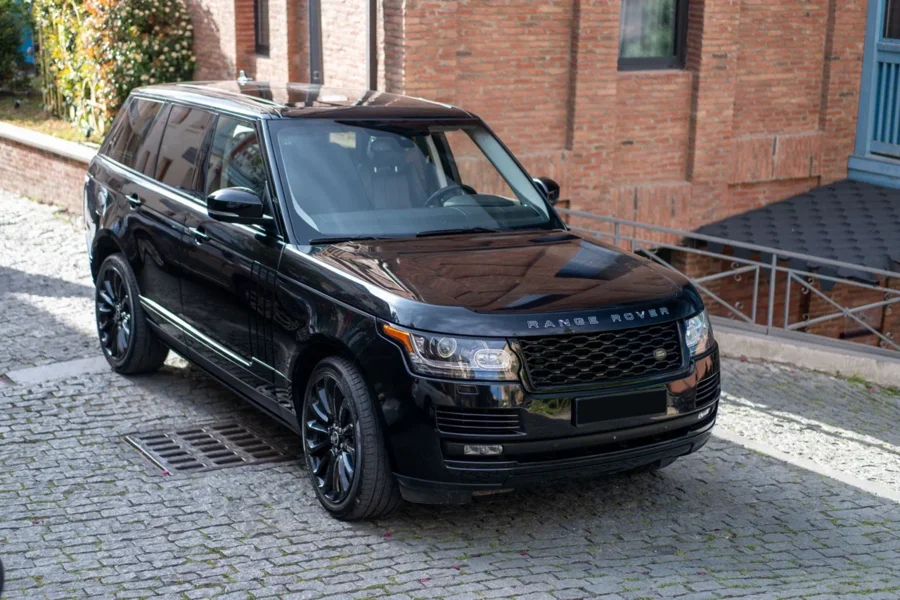
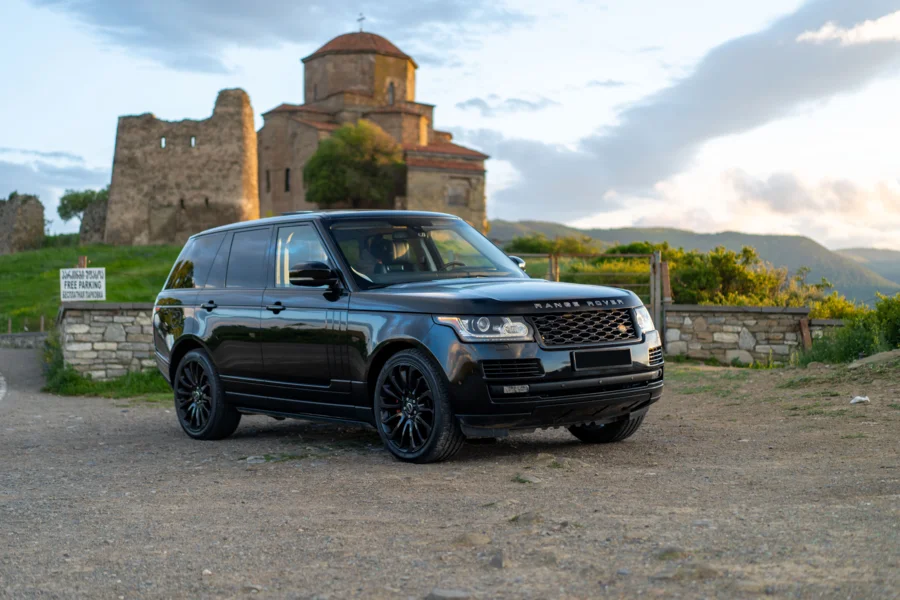
Detailed Range Rover review

We have compiled a comprehensive guide to the interior and options of different generations (2010–2026) and models (Range Rover, Sport, Velar) of the Range Rover. In it, our experts discuss finishing materials (leather, Alcantara, fabrics), the availability of a built-in refrigerator/minibar, ergonomics (seats, controls, accessibility), “premium quality” feel, panoramic roof, and other comfort options. 

Interior trim and materials

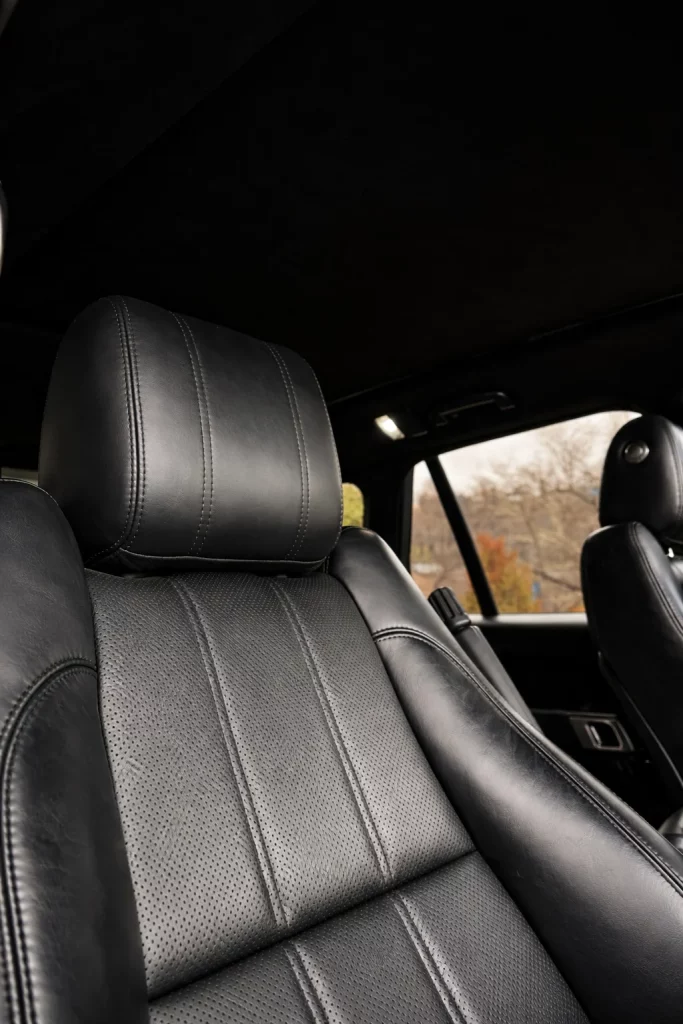
Range Rover interiors are traditionally made from the highest quality materials. The more expensive trim levels feature genuine Windsor leather (often semi-aniline) in dark or light colors (Ebony, Ivory, Light Cloud, etc.), which is dense, soft, and pleasant to the touch. In addition to leather, modern Range Rovers (especially after 2022) offer new premium textile inserts – a combination of high-tech Ultrafabrics™ microfiber and Kvadrat™ wool.

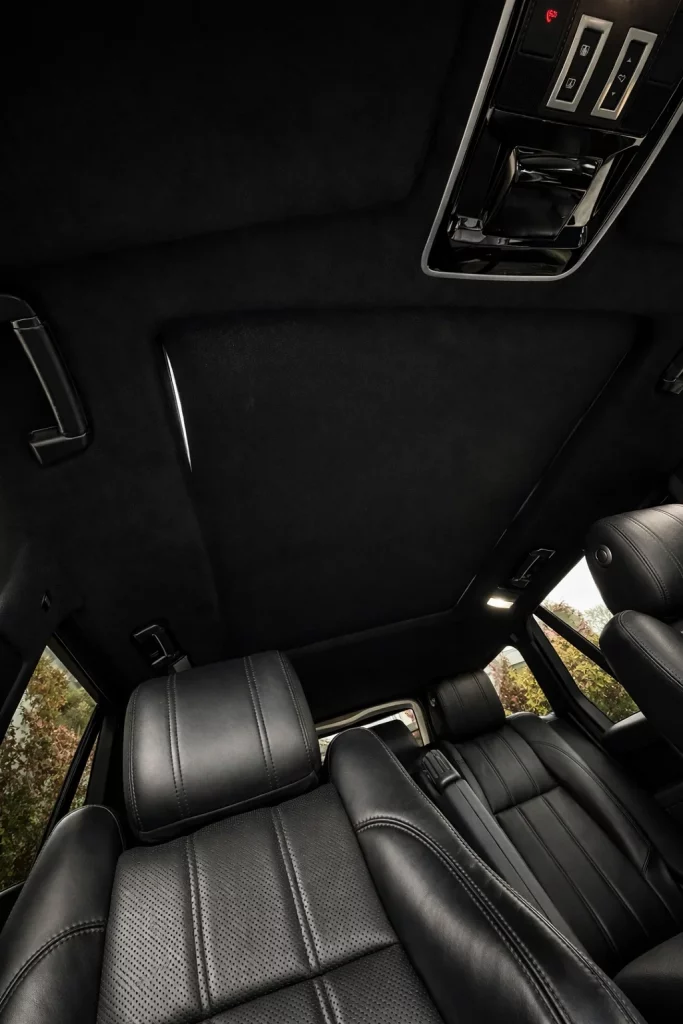
These are eco-friendly alternatives to leather that look stylish and feel comfortable, have no noticeable odor, and save some weight. The top-of-the-range SV Bespoke and Autobiography versions feature exclusive elements: Alcantara (Suedecloth) on the ceiling and body pillars, wood veneer panels (e.g., poplar, oak, or makmehra), and ceramic and metallic accents on buttons and handles. Our experience shows that in the new models, the emphasis has shifted towards minimalism and technology: large touch screens are integrated into austere horizontal panels, but the quality of the materials has not suffered – it is still top notch. In general, the interior is designed in the brand’s signature style: natural leather is combined with expensive lacquered trim and well-designed buttons.

Ceiling materials: Almost all Range Rover versions feature a panoramic sunroof with a fabric or Alcantara curtain. SV versions feature a black Alcantara ceiling, which adds to the closed coupe atmosphere. In standard configurations, the ceiling is upholstered in soft light-colored fabric or artificial suede, which is high-quality with no visible seams. 

Refrigerator and minibar

Rent a Range Rover and Range Rover Sport (especially in the Autobiography, SV, and Executive Lounge configurations) offer an optional built-in refrigerator in the center console. This is a compact electric box, usually for four 0.5–0.75 liter bottles, with cooling down to ≈+5°C (powered by 12V). According to customer experience, it can handle drinks even in hot weather and keeps them cool throughout the trip.

Let’s note right away: this refrigerator is more of a luxury bonus than a necessity. We sometimes hear jokes from customers like, “None of my friends have ever used the refrigerator in their car, so why do I need it?” Indeed, if you expect moderate use, you can do without it. However, many car owners note its usefulness on long trips: one of our customers emphasized that the small compartment always comes in handy in winter (to defrost drinks) and in summer (to drink only cold drinks in the heat). 

Ergonomics: seats, controls, accessibility

Seats. In the Range Rover, the front seats are a veritable throne for the driver and passenger. They are multi-position adjustable (up to 20–24 directions in new models): you can change the height, angle of the backrest and cushion, extend the support section under the thighs, and adjust the side support and lumbar support. We pay close attention to the seats: all motors and buttons must work smoothly, without jamming or extraneous noises. Expensive versions feature massage functions with several modes (waves, dots, etc.). Our experience shows that you should try each mode and feel the difference—the massage is truly noticeable and helps you relax during the trip. All these “little things” affect overall comfort. According to our customers’ experience, even minor discomfort in the seat can be felt strongly during long journeys, while a properly selected seat allows you to drive several hundred kilometers without fatigue.

Accessibility. Range Rover is known for its “Command Driving Position” – a raised seating position with excellent visibility. This is convenient, but the downside is heavy doors and a high threshold. In practice, we recommend checking how easy it is to get in and out of the car: open the door completely, sit down and stand up. Make sure that nothing gets in the way: optional deployable aluminum side steps significantly reduce the effort required to get in. Many customers, especially those who are short or elderly, appreciate this option, which is available on some versions as an option. Also, pay attention to the interior layout: all cars in this class have a storage area between the driver and passenger, cup holders in the armrests, and numerous niches in the doors. 

A sense of quality “at your fingertips”

The key sensation in a premium interior is the materials and assembly. When we first sit in a Range Rover, our hand automatically slides over the trim elements: the soft-touch dashboard panels, the stainless steel on the buttons, the thick pile of the carpets. The door handles are particularly impressive: they are built into metal frames and make a satisfying “thunk” sound when pressed – so solid that it brings a smile to your face. There are simply no “cheap buttons” in the Range Rover—every toggle and switch has a pleasant weight and a good fit. For example, one of our employees compared the sound of the doors closing to those of a Rolls-Royce—they slam shut so tightly and solidly.

Finishing materials are used throughout the interior. We even pay attention to the lower parts of the doors and niches – they are covered with soft plastic or leather, not hard, inexpensive material. The wood inserts on the dashboard and doors are real natural veneer, not imitation: smooth and even, without any lacquer smudges, well fitted into the panels. The leather on the seats is thick and elastic, with even seams and no protruding threads. All these little details inspire confidence: our customers literally run their hands over the front panel and note the absence of any play. 

Panoramic roof and visibility

All current Range Rover models offer a panoramic roof, often large and covering almost the entire length of the interior. The Range Rover Sport and Velar usually have multi-panel panoramic sunroofs that are covered by electric blinds. The space and light that such a roof provides have a noticeable effect on the feeling of freedom: our customers often say that with the roof fully open, the interior seems to “open up to the landscape.” One of them described it this way: “When you’re driving on the highway, it feels like you’re not in a car, but under a wide glass roof — it’s very cool.”

Additional comfort and premium options

Range Rover offers a variety of additional options. Heated steering wheel is usually included as standard or in the Climate/Comfort packages – it is easily activated with a button and quickly warms your hands. Heated center armrest and door armrests (optional) are especially important in cold climates.

Massage functions are perhaps a must-have feature in top-of-the-line trim levels. A total of 3-4 back and neck massage modes are available. In our experience, regular drivers really feel relaxed after 20-30 minutes of massage – their backs don’t ache. Our customers are constantly surprised: “I thought this massage was just a marketing gimmick, but it really does relieve fatigue.”

Ambient lighting (panoramic interior lighting) allows you to choose from a wide range of colors (up to 30 shades). Customers like to change the color of the lighting to suit their mood: cool white or blue add a “technological” feel, while warm orange and sand tones create a cozy atmosphere. In addition, in the higher-end versions, it is worth paying attention to the audio system: the standard Meridian (Signature) with 23-35 speakers provides truly powerful and clear sound. We always recommend turning on your favorite music and evaluating the volume and uniformity of the sound: there are no “dead” zones, and the bass does not “rumble” in the doors.

Special Offer Range Rover for Long-Term Rentals